As team members in the event production industry, our ultimate mission almost always involves communicating a message to our audience. Ironically, the biggest barrier to this too often involves communicating with each other. When the stage lights are up and the talent is on-stage, it is essential that the production team can clearly communicate with each other to create those seamless moments for the audience.
The heart of this communication is generally a director or stage manager “calling” the show for the team. This person is responsible for articulating their vision for the show, in a way that each team member can quickly and consistently understand.
One key aspect to this is using consistent language. For example, there are a handful of common terms to ask a lighting director to turn off the front stage wash, such as “Stage Wash Down”, “Douse Front Light”, or even just “Lights Down”. By deciding in advance which of these phrases to use, the team can more quickly react and understand which cues are meant for them.
App-based rundown software like
ScriptElephant assist teams with this by allowing script writers to assign names for each possible lighting scene. This allows the script writer to consistently re-cue these same scenes each time they are needed. This also allows the lighting operator to see a full list of each lighting scene in advance, so they can easily program their console with the same scene name the show caller will use.
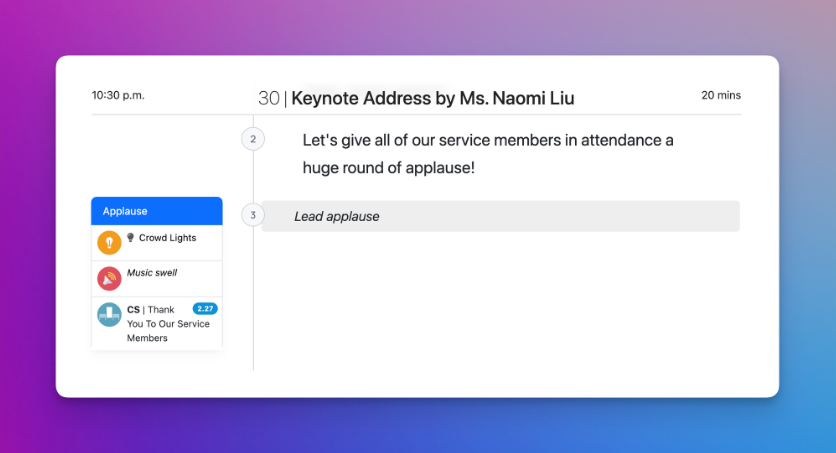
Another important factor is making sure that the show caller can quickly explain a complex cue, so that operators in each department can hit their marks simultaneously. A trick for this is for the show caller to use a short name that has a specific meaning for each department.
For example, the show caller can announce to their team:
"We’re coming up on ‘applause’. For this cue, lighting will be on crowd lights, music will swell, graphic C.21 will play, and cameras will be on wide.
Standby for ‘applause’. Ready, and... go."